Today, on 28 August, Germany’s prestigious national award, the Goethe Medal, was presented in Weimar to composer Arvo Pärt, Italian translator Anita Raja, and Greek theatre director Prodromos Tsinikoris. The awards were presented by Goethe-Institut President Gesche Joost at a formal awards ceremony at Weimarhalle. The award was accepted on behalf of Arvo Pärt by his son, Michael Pärt, Chairman of the Board of the Arvo Pärt Centre.
The award recognises the laureates’ distinguished creative work and their contribution to open cultural dialogue. The Goethe-Institut noted that the work of all this year’s laureates is an outstanding expression of the European spirit.
Gesche Joost emphasised the exceptional courage shown by all the laureates in their lives and creative work, as well as their unwavering belief in the possibility of the impossible.
“With his tintinnabuli compositional technique, Arvo Pärt has succeeded in touching and connecting people all over the world. With music that seems so simple in its essence and yet is so profound. Pärt has never ceased to believe in the possibility of the impossible: that music can be something more, creating a space for humanity,” Joost said.
“Arvo Pärt is the first Estonian to receive the Goethe Medal. This is an important sign of the strength of German-Estonian relations and, in the context of the war in Ukraine, it also symbolises the solidarity of Western and Eastern Europe,” Joost emphasised.
At the ceremony, Michael Pärt conveyed Arvo Pärt’s heartfelt thanks for this great honour.
“More than forty years ago, our family arrived in the German-speaking world and discovered that we had not arrived among strangers. People and institutions here gave my father trust and freedom – and gave his music the space to spread its wings,“ noted Michael Pärt.
“For this recognition – and for all that was received along the way – we are deeply grateful.“
In his speech, Michael Pärt also spoke of the need to listen to music with full attention and with the heart to receive what lies behind it. “Perhaps listening with the heart is also one way of experiencing: first comes the music, and then – perhaps – understanding,” he said.
Arvo Pärt emigrated with his family from Soviet Estonia in 1980, initially moving to Vienna. A year later, thanks to a scholarship from the DAAD (German Academic Exchange Service), the family settled in Berlin, which remained Arvo Pärt’s home for 30 years.
The majority of Arvo Pärt’s major works were completed during his years living in Germany, including “Berliner Messe”, which was created for the 90th German Catholic Church Days held in Berlin in May 1990 – the first after the fall of the Berlin Wall. One of Arvo Pärt’s most important German-language choral cycles, the liturgical text-based “Sieben Magnificat-Antiphonen” (1988/1991), commissioned by the Berlin RIAS Chamber Choir for its 40th anniversary, also dates from the same period. The large-scale works “Passio” (1982), “Te Deum” (1985/2007), and “Miserere” (1989/1992) were also written during this period.
The composer’s long-term fruitful collaboration with the renowned producer Manfred Eicher also began in Germany, under whose label ECM numerous first recordings of Arvo Pärt’s works and original albums have been released. Arvo Pärt’s later work includes “Vater unser” (2005/2011), based on the German text of the Lord’s Prayer, and dedicated to Pope Benedict XVI.
The Goethe Medal is an official decoration of the Federal Republic of Germany that has been awarded since 1955. It is the most important award honouring foreign figures in education and culture for their contribution to promoting the German language and culture in their home countries. The medal also pays tribute to efforts to keep cultural dialogue alive.
The Goethe Medal jury includes the heads of several important German cultural institutions as well as representatives of the German Foreign Office and the Goethe-Institut. This year, the jury was chaired by dramaturge, essayist and writer Thomas Oberender. The Goethe Medals are presented in Weimar on 28 August, the birthday of Johann Wolfgang von Goethe.
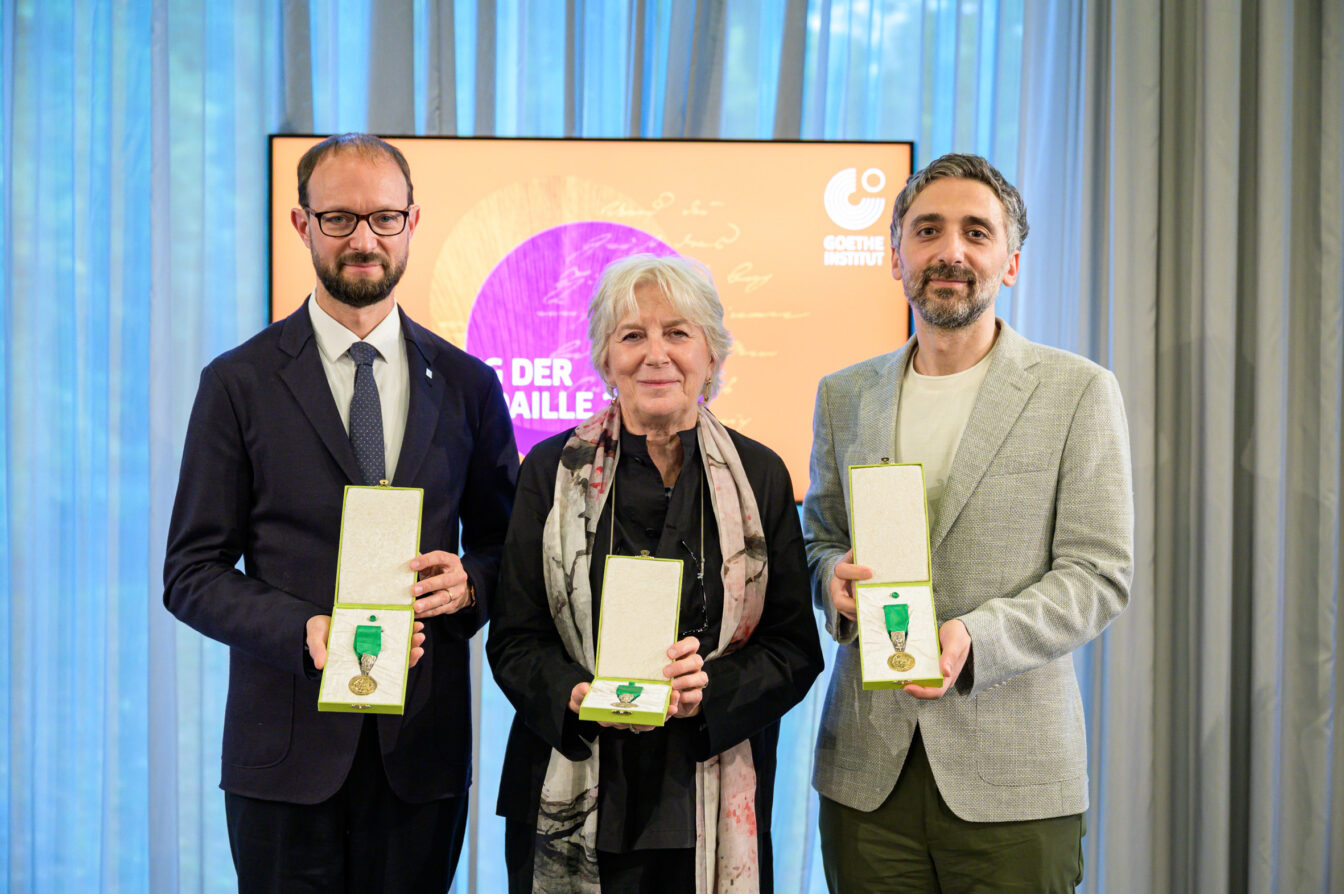
Michael Pärt, Anita Raja and Prodromos Tsinikoris. Photo: ©Henry Sowinski
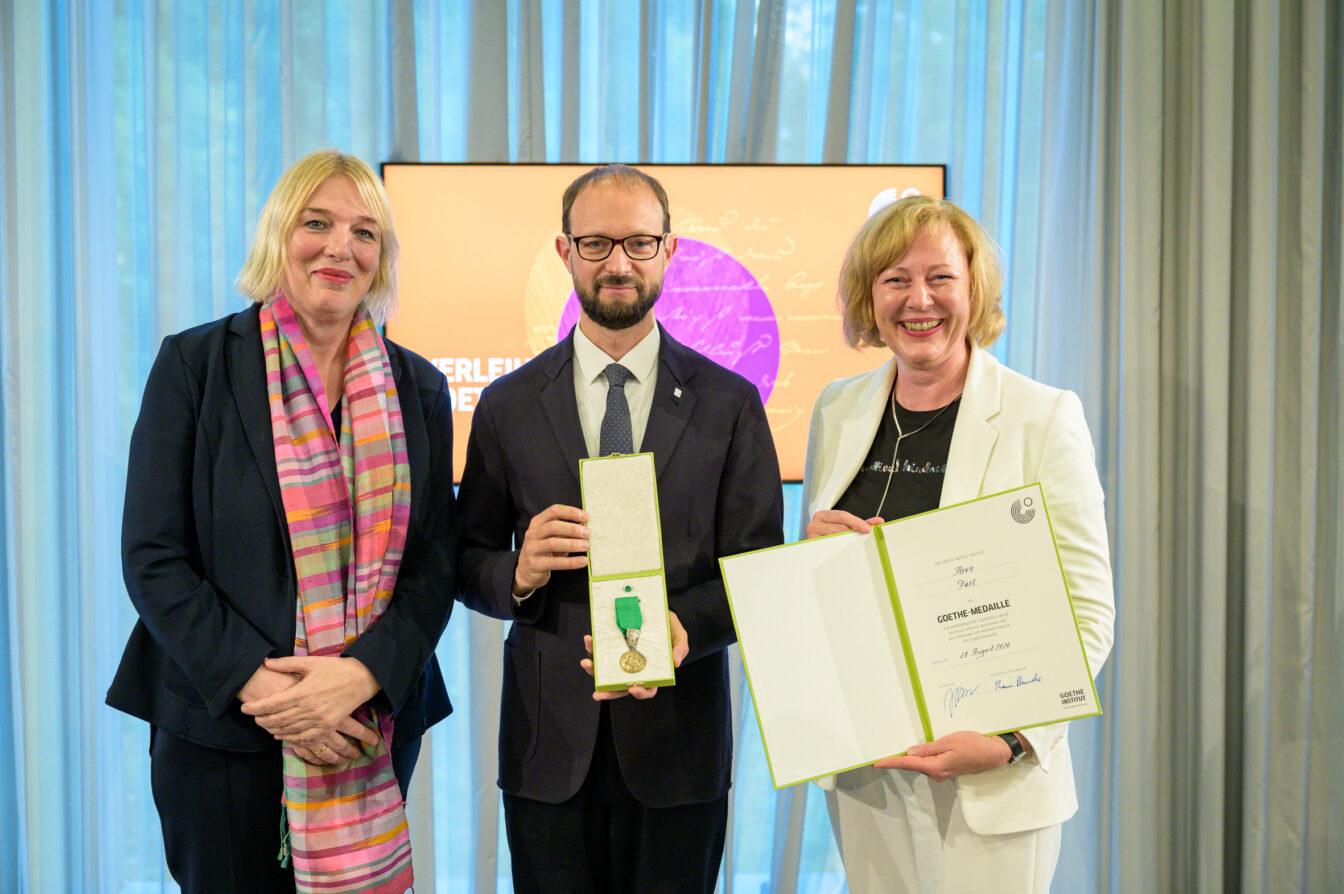
Maren Niemeyer, Director of the Goethe-Institut in Tallinn, Michael Pärt and Gesche Joost, President of the Goethe-Institut. Photo: ©Henry Sowinski
See more: Goethe-Institut press kit with speeches (in German).